
Airius Fans vs. HVLS Fans
Designed for Temperature Control.
Not Just Air Movement.
HVLS (High Volume, Low Speed) fans and Airius destratification fans both move air throughout a facility. The difference is what they’re engineered to accomplish.
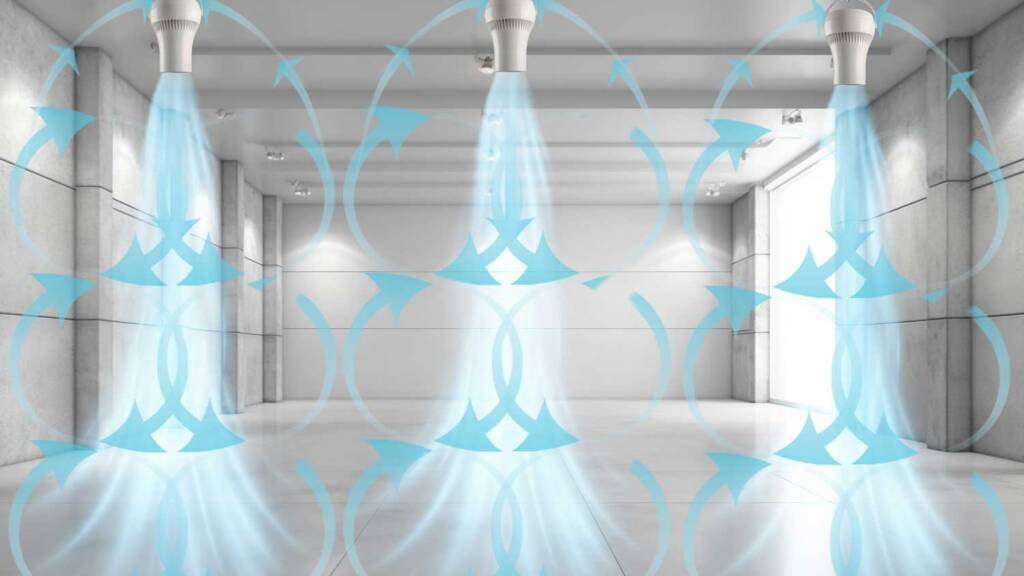
HVLS fans are designed to move large volumes of air using oversized exposed blades. Airius fans are engineered specifically to combat thermal stratification by continuously returning conditioned air to the occupied zone where people work, products are stored, and processes take place.
For facilities focused on temperature consistency, HVAC efficiency, occupant comfort, and energy savings, that difference matters.
Airius vs. HVLS at a Glance
Airius Destratification Fans
- Heating cost reductions of 20-70% are not uncommon
- Designed specifically to combat thermal stratification
- Continuously returns conditioned air to the occupied zone
- Better suited for complex building layouts
- Multi-point airflow distribution
- No large exposed blades
- Compatible with overhead cranes
- Available with integrated air cleaning technology
HVLS Fans
- Primarily focused on air movement and perceived cooling
- Designed to move large volumes of air
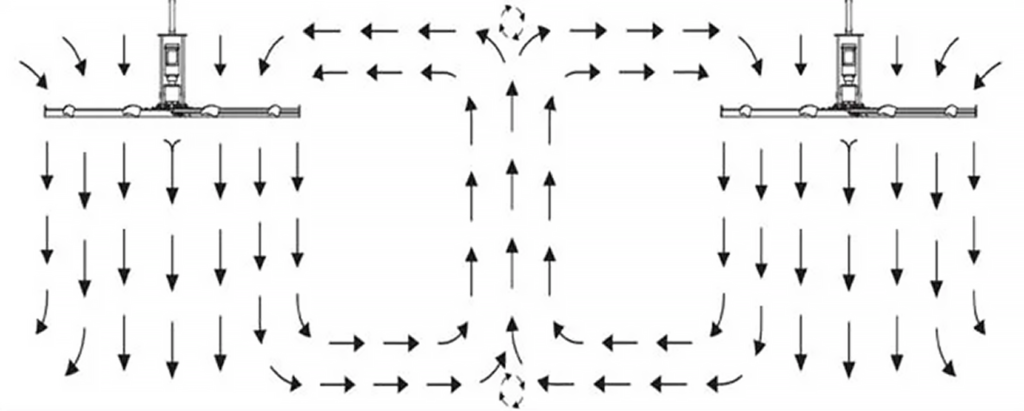
- Broad-area air circulation
- Large airflow zones
- Best suited for open floor plans
- Large exposed blades
- Clearance limitations may apply
- Air circulation only
Temperature Management vs. Air Movement
Airius Destratification Fans
- Designed specifically to combat thermal stratification
- Continuously returns conditioned air to the occupied zone
- Supports more consistent floor-to-ceiling temperatures
- Helps improve HVAC efficiency
- Helps reduce heating and cooling costs
Temperature stratification can reach approximately 0.5°F per vertical foot in many facilities. Airius fans are engineered specifically to address this challenge by continuously recirculating conditioned air throughout the occupied space.
HVLS Fans
- Designed to move large volumes of air
- Creates broad airflow coverage
- Commonly used for occupant cooling
- Focused on air circulation rather than thermal destratification
HVLS fans are designed to create airflow and improve occupant comfort through air movement. Their primary focus is broad-area circulation rather than continuously redistributing conditioned air from ceiling to floor.
Energy Savings & HVAC Efficiency
Airius Destratification Fans
- Heating cost reductions of 20-70% are not uncommon
- Improves HVAC distribution efficiency
- Helps reduce HVAC runtime
- Reduces energy waste caused by thermal stratification
- Helps maximize the effectiveness of existing HVAC systems
By continuously returning conditioned air to the occupied zone, Airius helps facilities make better use of the heating and cooling they are already paying for.
HVLS Fans
- Designed primarily for large-scale air movement
- Commonly used to improve occupant comfort
- Broad airflow coverage
- Not specifically engineered to optimize HVAC performance through thermal destratification
While HVLS fans can improve comfort through air movement, they are generally selected based on airflow coverage rather than temperature equalization and HVAC optimization.
Designed for Real-World Facilities
Airius Destratification Fans
Most facilities aren’t empty boxes. Warehouses contain racking systems. Manufacturing facilities contain machinery and production lines. Retail stores contain aisles and displays. Many buildings also have mezzanines, offices, lighting systems, sprinkler systems, and overhead cranes.
Airius utilizes a multi-point airflow strategy that allows airflow to be distributed throughout the facility while integrating easily into existing infrastructure.
Benefits include:
- Better suited for racks, equipment, and mezzanines
- Multi-point airflow distribution
- No large exposed blades
- No guy wires
- No safety nets or cages
- Compatible with overhead cranes
- Minimal impact on lighting or sprinkler layouts
- Flexible placement throughout the facility
HVLS Fans
HVLS fans are commonly deployed in large open spaces where a small number of large-diameter fans can provide broad airflow coverage.
Because of their size, fan placement often requires additional consideration for:
- Ceiling clearance
- Lighting systems
- Sprinkler layouts
- Structural conditions
- Overhead equipment
HVLS systems are often best suited for wide-open floor plans with minimal overhead obstructions.
Patented Airflow Technology
Airius Destratification Fans
Airius utilizes patented Multi-Vane Stator Technology, Venturi Nozzle Technology, and Side Intake Bypass Technology to create high-velocity columnar airflow designed specifically to combat thermal stratification.
Benefits include:
- Increased airflow velocity
- Increased throw distance
- Improved air mixing
- Ceiling-to-floor airflow delivery
- Improved HVAC efficiency
- Reduced energy consumption
Rather than simply moving air, Airius is engineered to improve how conditioned air is distributed throughout a facility.
HVLS Fans
HVLS systems rely on large exposed blades rotating at low speeds to move large volumes of air throughout a space.
Comparable Airflow. Different Objectives.
Both Airius and HVLS systems create airflow throughout a facility. The difference is what that airflow is designed to accomplish.
HVLS fans are designed to move large volumes of air and create broad circulation throughout a space.
Airius fans are engineered specifically to reduce thermal stratification by continuously returning conditioned air to the occupied zone. This helps facilities improve temperature consistency, optimize HVAC efficiency, and reduce energy consumption while maintaining occupant comfort.
WHY FACILITIES CHOOSE AIRIUS FANS
- Heating cost reductions of 20-70% are not uncommon
- Designed specifically to combat thermal stratification
- Continuously returns conditioned air to the occupied zone
- Patented airflow technology
- Multi-point airflow distribution
- Better suited for complex building layouts
- No large exposed blades
- Compatible with overhead cranes
- Available with integrated air cleaning technology
Ready to Improve Temperature Consistency and Reduce Energy Costs?
Talk with an Airius airflow specialist to learn how destratification can improve HVAC efficiency, reduce energy consumption, and create more consistent temperatures throughout your facility.