Improving Passenger Comfort and HVAC Efficiency with Destratification Fans for Airports
Airport terminals combine vast open spaces, high ceilings, extensive glazing, long concourses, frequently opening exterior doors, and constantly changing passenger volumes. These conditions can make maintaining consistent temperatures throughout the occupied areas difficult and energy intensive.
Airius destratification fans can help airports improve air distribution, reduce hot and cold spots, and make better use of conditioned air throughout terminals, gate areas, baggage halls, and other large passenger spaces.
The Challenge
Airports experience unusually variable heating and cooling demands. Passenger volumes can change dramatically throughout the day, while entrances, jet bridges, baggage areas, and other exterior connections continually expose portions of the terminal to outdoor conditions. Large expanses of glass can contribute additional solar heat gain in summer and heat loss during colder weather.
High ceilings create another challenge. Warm conditioned air can accumulate well above passengers and employees while HVAC systems continue operating to maintain temperatures at occupied level. Long concourses and complex terminal layouts can also develop localized hot and cold areas where conditioned air is not distributed effectively. For airports operating around the clock, inefficient air distribution can translate into substantial unnecessary heating and cooling demand.
The Airius Solution
Airius fans can provide continuous, controlled circulation throughout large airport spaces, helping redistribute conditioned air between high ceilings and occupied areas while complementing existing HVAC systems.
For airport terminals, two Airius systems are particularly well suited.

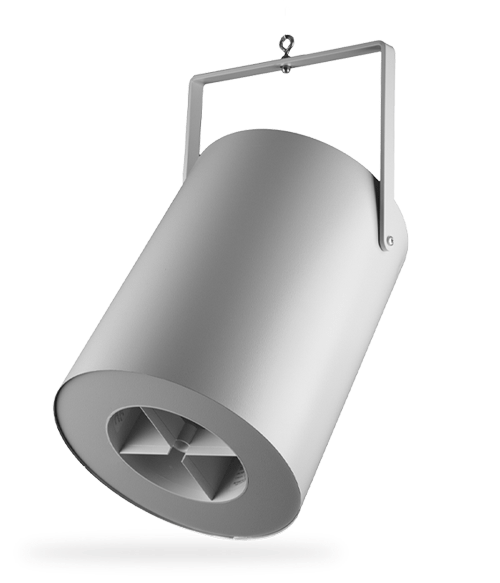
Designer EC Series
The Designer EC Series is particularly well suited for prominent passenger areas where airflow performance must also complement the terminal's architecture. Its powder-coated aluminum housing can be customized to integrate with visually sensitive spaces such as departure halls, arrival areas, lounges, atriums, and terminal entrances. Models are available for exceptionally high ceilings, making the Designer Series suitable for the large architectural volumes common in modern airports. The combination of discreet design, controlled airflow, and building-management integration allows circulation to become part of the terminal environment without visually dominating it.
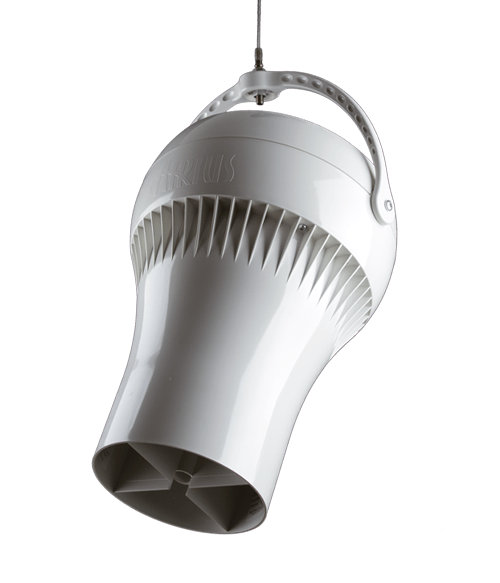
Air Pear EC Series
The Air Pear EC Series is ideal for concourses, gate areas, baggage claim halls, ticketing areas, and other expansive terminal spaces with high ceilings. Multiple models accommodate ceiling heights ranging from approximately 15 to 100 feet, allowing airflow to be matched to different areas of the terminal. Its focused columnar airflow helps return conditioned air from upper portions of the building toward passenger level, reducing temperature stratification across large spaces. Variable-speed EC motors and BACnet or 0–10V integration allow airflow to be coordinated with existing airport building-management systems and adjusted according to occupancy, seasonal conditions, and individual terminal zones
Potential Results
A properly engineered Airius installation could help reduce floor-to-ceiling temperature differences, minimize localized hot and cold areas, improve passenger and employee comfort, and help existing HVAC systems distribute conditioned air more effectively. Improved destratification can also help airports recover conditioned air that would otherwise remain trapped within high ceiling spaces, potentially reducing unnecessary heating and cooling demand across facilities that operate for extended hours. Different fan models and control zones can be used throughout gate areas, concourses, baggage halls, entrances, and other passenger spaces according to their individual conditions.
Better airflow is ready for takeoff
Every airport terminal has different ceiling heights, passenger flows, glazing, entrance configurations, HVAC zones, security requirements, and architectural features.
Airius systems can be selected and positioned around those conditions, using Air Pear fans where long-throw circulation and flexibility are priorities and Designer Series fans where airflow performance must also integrate with prominent public architecture.
The objective isn’t simply to condition the enormous volume of air inside a terminal. It’s to keep that conditioned air where passengers and employees actually experience it.