
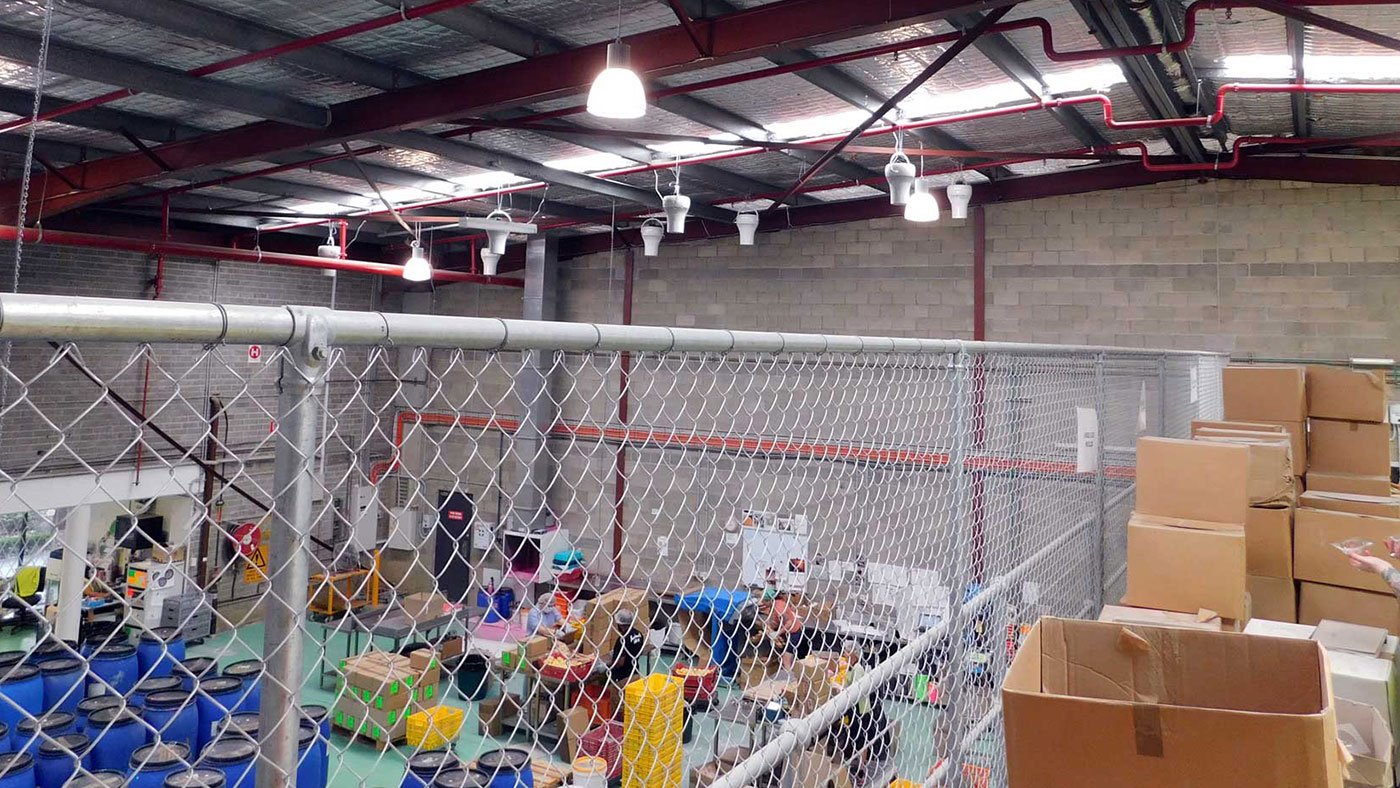
Determining how many destratification fans a commercial building needs involves more than calculating square footage. Ceiling height, building layout, airflow performance, and the intended application all influence the number, size, and placement of fans required. For engineers and facility managers, the objective is to develop an airflow system that provides effective coverage without unnecessary equipment.
Can You Calculate Destratification Fans by Square Footage?
Square footage is a starting point, but it doesn’t provide enough information to determine the correct fan quantity. Two buildings with identical floor areas may require different configurations depending on ceiling height, storage racks, equipment, and airflow obstructions.
Airius offers multiple destratification fan models with different airflow capacities and throw distances, allowing systems to be configured for specific building requirements.
How Does Ceiling Height Affect Fan Selection?
Ceiling height is one of the most important factors in destratification fan sizing. A fan installed at 15 feet must meet different airflow requirements than one installed at 40 feet. Engineers need to evaluate whether the selected model can deliver the required airflow at the intended mounting height.
This is where airflow velocity profiles and throw-distance data become important. Rather than selecting a fan based solely on its CFM rating, engineers should consider how its airflow performs over the full distance to the occupied level.
The Airius Air Pear Series uses a patented multi-vane stator and Venturi nozzle to produce focused, columnar airflow for commercial and industrial applications.
Why Does Fan Placement Matter?
Proper spacing is just as important as selecting the right fan. Racking, production equipment, structural elements, and other obstructions can influence airflow distribution. A fan layout should account for these features rather than assuming air will move uniformly throughout the entire building.
A distributed system of strategically positioned fans allows airflow to be directed toward areas where circulation is needed while accommodating the building’s operational requirements. For example, a warehouse with tall storage racks may require a different layout than an open manufacturing facility of the same size.
What Information Is Needed to Design a Destratification System?
Before specifying fans, engineers should evaluate:
- Building dimensions: Floor area, ceiling height, and overall geometry.
- Mounting height: Distance between the proposed fan location and the occupied level.
- Airflow requirements: Required throw distance, velocity, and coverage.
- Obstructions: Racking, equipment, partitions, and overhead infrastructure.
- HVAC configuration: Supply and return locations, existing circulation, and heating or cooling requirements.
- Controls: Whether fan operation will be fixed-speed, variable-speed, or integrated with a building automation system.
Airius offers EC motor configurations and control options that support integration with existing building systems.
Is One Large Fan Better Than Multiple Smaller Fans?
Not necessarily. Fan quantity should be based on the required airflow distribution rather than the assumption that fewer, larger fans provide better coverage. Airius uses a distributed approach, positioning compact destratification fans throughout a facility to deliver focused airflow where it is needed.
This can provide flexibility in buildings with overhead cranes, lighting, storage racks, or other infrastructure that must be considered during system design.
Get the Right Fan Layout for Your Facility
There is no universal fan-to-square-footage ratio that applies to every commercial building. Effective destratification depends on matching fan performance and placement to the building’s actual conditions. Airius works with engineers, contractors, and facility managers to identify appropriate fan configurations based on ceiling height, layout, and airflow requirements.
Explore Airius destratification solutions or request a quote for your facility.