
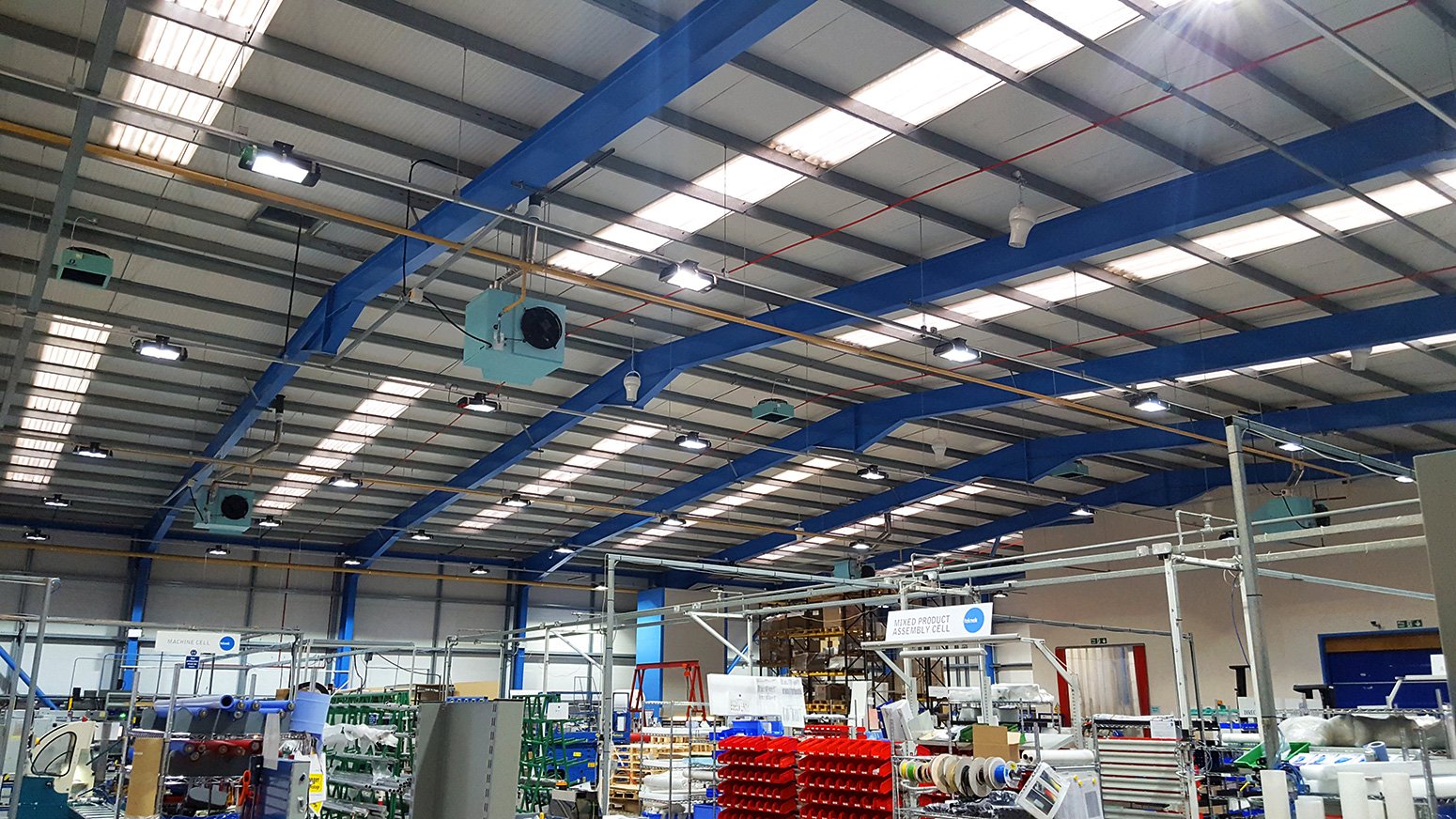
As temperatures rise, cooling costs quickly become one of the largest operating expenses for commercial buildings. This is especially true in facilities with high ceilings and large open layouts, where maintaining consistent temperatures can be difficult.
In many cases, high cooling costs are not just caused by HVAC capacity — they are the result of uneven air distribution throughout the space.
Why are large commercial buildings difficult to cool?
Large buildings present unique cooling challenges due to their size and air volume. High ceilings allow warm air to accumulate overhead, while conditioned air may not circulate evenly at the occupied level.
This can lead to areas that feel warm even when the air conditioning is running, forcing systems to operate longer to maintain setpoint temperatures.
Why does air conditioning struggle in warehouses and tall spaces?
In tall environments, airflow becomes a limiting factor. Conditioned air delivered through HVAC systems does not always reach all areas of the building evenly.
Without proper air movement:
- Warm air can remain trapped near the ceiling
- Conditioned air may stay localized instead of spreading
- Temperature differences develop across the space
This makes it difficult for HVAC systems to cool efficiently.
How does air movement affect cooling efficiency?
Air movement plays a critical role in how effectively a building is cooled.
When air is evenly distributed:
- Conditioned air reaches the entire occupied space
- Temperature differences are reduced
- HVAC systems can maintain comfort with less runtime
Without proper air circulation, cooling systems must work harder to compensate for uneven temperatures.
How can you reduce cooling costs without upgrading HVAC systems?
One of the most effective ways to improve cooling efficiency is to improve how air is distributed within the building.
Destratification systems help circulate air throughout the space, ensuring that conditioned air is not concentrated in one area while other areas remain warm. By improving air mixing, facilities can make better use of the cooling they are already paying for.
This approach focuses on optimizing performance rather than increasing capacity.
What are the signs of poor cooling distribution?
Buildings with airflow issues often show clear signs during warmer months, including:
- Areas that feel warm even with air conditioning running
- Uneven temperatures across different zones
- HVAC systems running continuously
- Higher-than-expected energy costs
- Ongoing comfort complaints
These are typically indicators that air is not being distributed effectively.
Where improving airflow makes the biggest impact
Air distribution improvements are most effective in buildings with:
- high ceilings
- large open floor plans
- significant cooling demand
- limited natural air movement
Common examples include warehouses, manufacturing facilities, retail spaces, gyms, and schools.
A more efficient approach to cooling large spaces
Reducing cooling costs is not always about installing larger HVAC systems. In many cases, it is about improving how air moves throughout the building.
By focusing on air distribution, facilities can stabilize temperatures, reduce unnecessary system runtime, and improve overall efficiency during the cooling season.
Learn more about improving cooling efficiency in your building
If your facility struggles to maintain consistent temperatures during warmer months, airflow may be the underlying issue.
Learn more about airflow solutions for large commercial spaces:
https://airiusfans.com/products/
Or speak with our team about your facility:
https://airiusfans.com/contact/