When evaluating air movement solutions for large commercial buildings, many facility managers compare HVLS fans and destratification fans. While both systems move air, they are engineered differently and deliver very different installation, operational, and integration outcomes.
Understanding those differences is critical when selecting the right solution for tall spaces.
How HVLS Fans Move Air
HVLS (High Volume, Low Speed) fans use large exposed blades to push air downward toward the floor. When that airflow hits the floor, it spreads outward in all directions. This outward movement creates what is commonly referred to as a floor jet.
When multiple HVLS fans are installed, their floor jets meet and create pressure zones that influence overall air movement. Proper spacing is essential to ensure performance.
How Destratification Fans Move Air
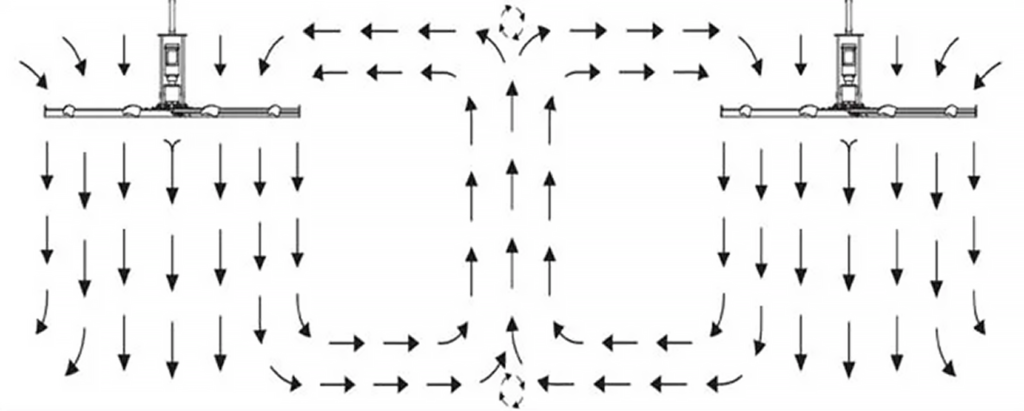
Destratification fans also move air downward and achieve floor-level airflow coverage. However, instead of using large exposed blades, they use engineered airflow patterns to create consistent vertical air mixing.
Air is moved from ceiling to floor, then gradually recirculates back upward, creating continuous mixing throughout the space. The result is controlled floor-to-ceiling temperature equalization without relying on oversized hardware.
Airflow is achieved across the floor area while maintaining full recirculation through the space.
Key Installation Differences
One of the most significant distinctions between HVLS and destratification systems is how they integrate into a building.
Destratification systems offer:
- Hidden blades
- Unobtrusive design
- No lighting redesign requirements
- No structural reinforcement
- No guy wires
- No protective nets or cages
- No height installation restrictions
- Compatibility with overhead cranes
- Resistance to crosswinds
- Single-phase power
- Low noise operation
- Multi-point system coverage
- Full replacement warranty
HVLS systems, due to their size and exposed blade design, require greater structural consideration and ceiling clearance planning.
In facilities with cranes, sports courts, lighting grids, or architectural constraints, these differences become operationally significant.
Coverage Strategy: Large Blades vs. Multi-Point Distribution
HVLS fans typically rely on fewer, large-diameter units to cover wide open areas.
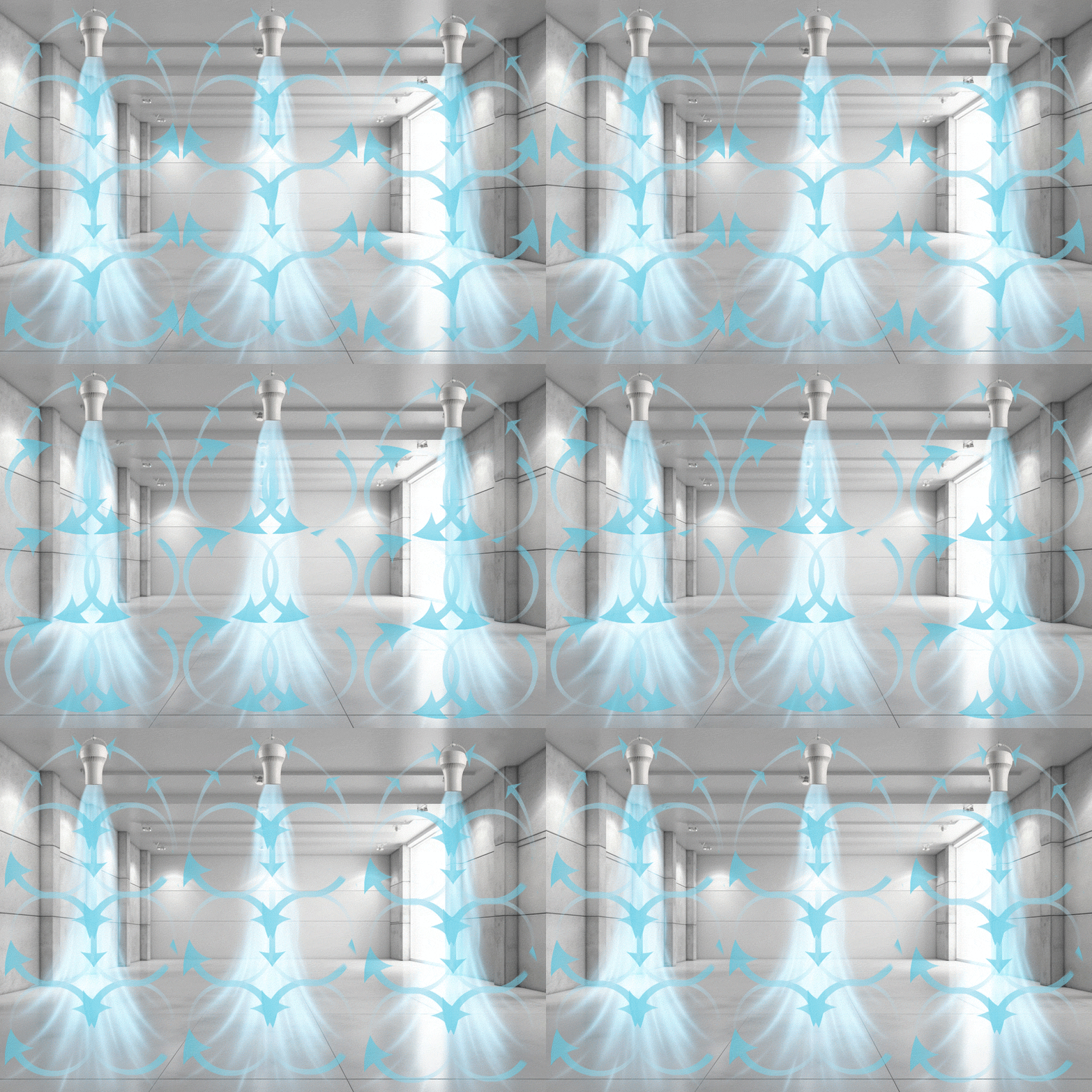
Destratification systems use a distributed, multi-point approach. Multiple smaller units work together to create balanced airflow throughout the entire building footprint.
This allows for better adaptability in complex layouts and more consistent vertical temperature control.
Maintenance and Practical Considerations
Destratification systems are designed to operate without yearly maintenance contracts, structural retrofits, or protective accessories. The absence of exposed blades reduces risk factors in active environments such as warehouses, athletic facilities, and manufacturing plants.
For facilities prioritizing operational simplicity and safety integration, these factors matter as much as airflow performance.
Which System Is the Better Choice?
YThe right solution depends on the building’s airflow problem.
If the goal is broad air movement for perceived cooling, HVLS fans may be considered.
If the goal is:
- Correcting vertical temperature layering
- Mitigating stratification
- Improving HVAC distribution efficiency
- Minimizing structural impact
- Integrating cleanly into complex facilities
- Destratification systems are engineered specifically for those objectives.
While both technologies move air, destratification systems are purpose-built to solve temperature stratification without introducing large mechanical structures into the space.
Choosing Based on Building Performance, Not Just Air Movement
Airflow performance is important — but so is how the system installs, operates, and integrates long-term.
In tall commercial buildings where stratification, safety, clearance, and structural simplicity are concerns, destratification provides a more adaptable and purpose-driven solution.
Talk with the team about your building layout: https://airiusfans.com/get-a-quote/
Learn more about destratification solutions: https://airiusfans.com/products/